Bodyweight exercise still needs a clear progression rule
An exercise using body weight can be demanding even when no external load is visible. Leverage, support, movement range and repetition structure can all change the task. A useful beginner plan treats those variables deliberately rather than assuming bodyweight means easy, universally safe or impossible to progress.
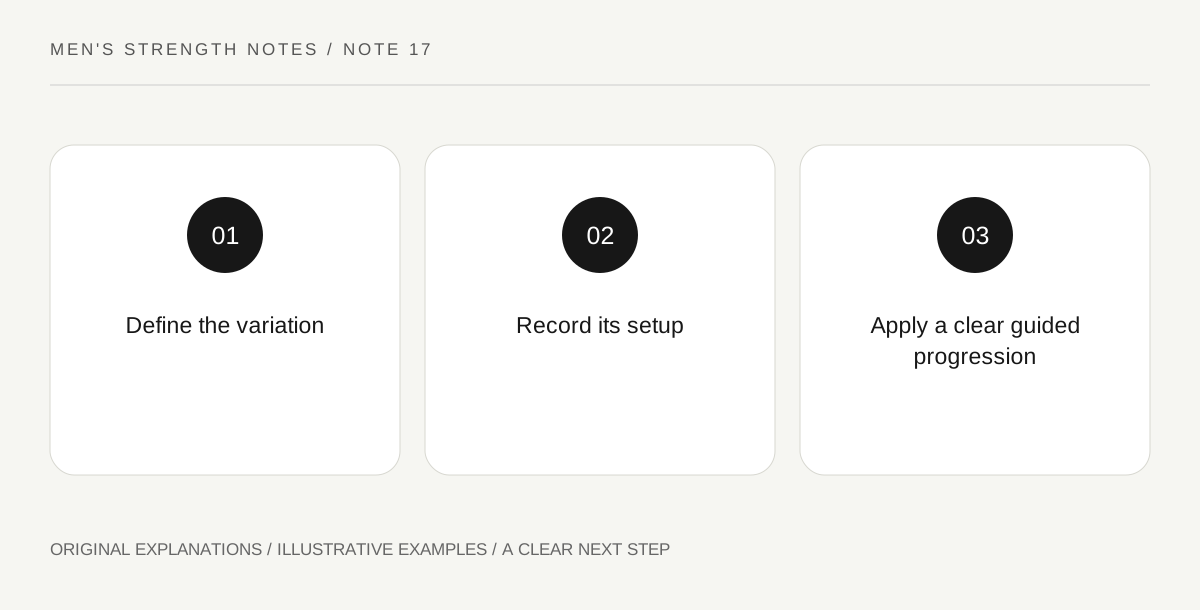
Original explanatory diagram. Read the full method and limitations below.
Identify the variation precisely
Write the actual version being taught, including support, body position and relevant surface. A wall-supported movement and a floor version are not the same task simply because both share an exercise name. ACSM recognizes bodyweight training among useful resistance options for healthy adults. That does not make every variation suitable for every person. Ask a qualified instructor to demonstrate the starting position, movement and finish. Do not use unstable furniture or an unsuitable doorframe because a video uses a similar household object. The setup and its intended use matter even when the only visible resistance is your body.
Choose a reference that is easy to reproduce safely. If a support height is part of the instruction, an identifiable piece of suitable equipment is more useful than balancing books or loose cushions to imitate a measurement. Do not turn a logging goal into an unstable construction. If the original arrangement is unavailable, ask how to adapt the task and record the new version. Repeatability is valuable only when the setup itself remains appropriate.
Recognize what makes the task change
A different support height, stance, range or tempo may alter demand. More repetitions are only one possible variable. Ask which change serves the plan and how it should be introduced. Do not remove support and add speed at the same time merely to create a harder-looking version. Keep the learning task manageable. An exercise can become more difficult without moving toward the original goal if the new variation mainly adds balance or coordination demands. A clear progression rule explains what remains constant, what changes and what would lead you to pause or return to another suitable version.
Record the setup behind the repetition count
A log saying twelve repetitions is incomplete when the support height or body position changes. Use a clear description or permitted private photograph of the setup, without capturing other people. Keep units and reference points consistent where relevant. Do not turn measurement into a requirement to reproduce an unsafe arrangement. If the environment changes, reassess the task. A hotel room, home floor and gym bench can differ in stability and space. Treat a new setting as a setup question rather than assuming a bodyweight routine travels unchanged into every available corner.
Keep symptoms and access in the decision
If wrists, shoulders, knees or another area are uncomfortable, stop and ask about appropriate instruction or clinical assessment. Do not force a variation because it has no weights and therefore seems harmless. An alternative can preserve training access without being a lesser moral choice. Review actual completed work and the agreed next step rather than comparing with a performer using a different body, surface and history. The useful outcome is a repeatable task and a clear change rule. It does not require a maximum repetition test, a floor-based version or a complex skill to qualify as strength work.
An illustrative variation log
Nate learns a supported bodyweight movement and records the support and position. When an instructor later changes the support height, he records a new task condition rather than comparing the repetition count without context. He does not add speed at the same time or assume the floor version is a mandatory graduation.
Practical checks
Optional checkboxes save only in this browser.
Questions that come up
Does bodyweight mean low intensity?
No. The demand depends on the variation and person. Treat setup and instruction seriously.
Must progress mean more repetitions?
Not always. An appropriate plan may change another variable, but the decision should be clear and suitable for the goal.
References and scope
These sources support the factual background. Examples and exercises are original illustrative teaching material. References do not imply endorsement.
- ACSM: Updated 2026 Resistance Training Guidelines — Individualized training, consistency, equipment options and limits of advanced techniques for healthy adults.
- MedlinePlus: Exercise and Physical Fitness — Exercise types, gradual participation and seeking advice when safety is uncertain.