Read sets and repetitions without turning an exercise card into a guessing game
An exercise card can look precise while leaving important terms unexplained. Sets, repetitions, load, rest and tempo describe different parts of a task. Learning the notation lets you ask better questions and follow a suitable plan, without assuming that a printed number is automatically appropriate for your body or experience.
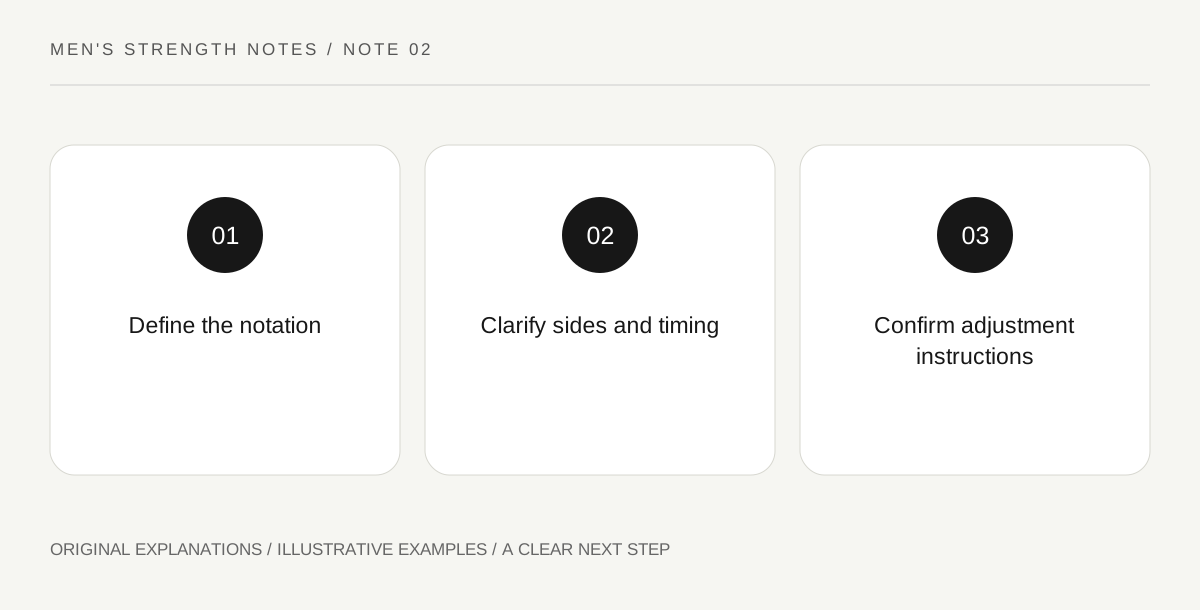
Original explanatory diagram. Read the full method and limitations below.
Separate a repetition from a set
A repetition is one complete cycle of the exercise as defined by the instruction; a set groups repetitions before the planned pause. Ask the instructor where the cycle starts and ends, because a partial movement or alternating sides can create confusion. A card marked three sets of eight is not the same as eight sets of three. The arithmetic may match in total repetitions while the organization differs. Write the notation in ordinary language if that helps. The purpose is understanding an existing suitable plan, not selecting these illustrative numbers as a program.
Clarify sides and equipment
For an alternating movement, ask whether the listed repetitions refer to each side or the combined total. For dumbbells, confirm whether the load entry describes each hand and the unit used. Keep the actual exercise variation visible: seated, standing and supported versions may have different instructions. Do not infer a missing unit from the size of a weight or an app's default. A record that is clear now can prevent an accidental change later. If an online plan leaves those details unresolved, seek a reliable explanation before following it rather than using the most demanding interpretation.
Make a small fictional reading exercise before the first session: write one line in the notation used by the plan, then explain it without abbreviations. Include the exercise, work, pause and unit. Have the instructor correct the interpretation. This takes the uncertainty out of the card before equipment is involved. Do not use an example from this article as a training dose; its purpose is checking the language. The same method is useful when a new app uses a different layout or abbreviates a term unexpectedly.
Read rest and tempo as separate instructions
Rest describes the pause between work periods, while tempo describes the timing of the movement itself. A rest entry does not tell you how quickly to perform each repetition. Ask whether a timing code is being used and what each part means. Different plans use different conventions, so do not assume a string of digits is self-explanatory. ACSM emphasizes individualization rather than rigid universal rules for healthy adults. The practical task is to understand the plan you are using and the reason for its structure, not to collect complex notation because it looks advanced.
Confirm what to do when the card does not fit
Ask how to respond if you cannot complete the planned work with the taught technique, if equipment is unavailable or if symptoms occur. A card should not pressure you to force a repetition or conceal uncertainty. Record what you actually did separately from what was planned, and discuss meaningful differences with the instructor. Avoid adding unfinished repetitions to the end as a punishment. A useful plan includes permission to pause and clarify. The notation supports communication; it cannot assess an injury, select your initial load or decide that every missed number requires more effort.
An illustrative notation check
A card says two sets of ten for an alternating exercise. Finn asks whether ten means per side and confirms the equipment unit before starting. He repeats the instructions back in plain language and records the actual completed work. The clarification prevents a doubled session caused by interpreting an ambiguous line independently.
Practical checks
Optional checkboxes save only in this browser.
Questions that come up
Does equal total repetition count mean identical training?
No. Set organization, load, rest and execution can differ. Read the whole instruction.
Should I guess when an app omits units?
No. Resolve the unit and exercise details before using the entry to select equipment or workload.
References and scope
These sources support the factual background. Examples and exercises are original illustrative teaching material. References do not imply endorsement.
- ACSM: Updated 2026 Resistance Training Guidelines — Individualized training, consistency, equipment options and limits of advanced techniques for healthy adults.
- MedlinePlus: Exercise and Physical Fitness — Exercise types, gradual participation and seeking advice when safety is uncertain.