Training to failure is not an entry requirement for a useful strength session
Online clips often show the final difficult repetition, which can make stopping earlier look like incomplete work. That is a poor starting assumption for a beginner. Learn the plan's intended effort and finishing rule before chasing failure, and distinguish a challenging exercise from a situation where technique or safety has become uncertain.
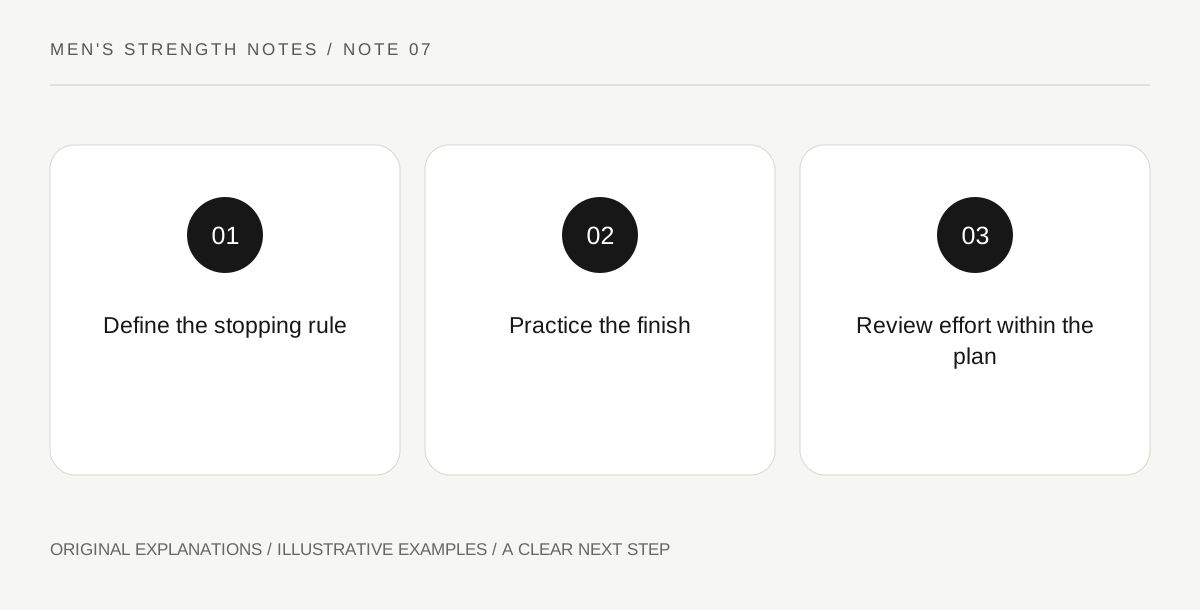
Original explanatory diagram. Read the full method and limitations below.
Define what the word means in context
People use failure to mean several things: stopping because a target was reached, being unable to complete another repetition or losing the intended technique. Ask the instructor which meaning applies in the discussion. These are not interchangeable events. A plan should explain when to finish a set and how to exit the exercise safely. A dramatic clip may show neither the setup nor the assistance nearby. Do not use an ambiguous phrase as permission to continue until something gives way. The teaching task is understanding the stopping rule before fatigue makes communication harder.
Keep current evidence within its scope
ACSM's 2026 update reports that training to momentary failure did not consistently change outcomes for the average healthy adult across the evidence reviewed. That does not mean effort is irrelevant or that every specialist program is identical. It does mean a beginner should not treat failure as a universal admission ticket to strength training. The guidance concerns healthy adults and does not replace a personal plan or clinical advice. Ask what level of effort serves your goal and experience. Avoid turning one research summary into the opposite rigid rule that nobody should ever use a challenging set.
Practice a clear finish
Learn the appropriate return, rack or release procedure with qualified instruction. Some exercises need a spotter or safety system, and equipment details matter. A machine path or rack does not make improvisation acceptable. If technique becomes unclear, discomfort appears or the task exceeds the taught arrangement, stop and ask. Do not recruit an unprepared stranger to rescue an attempt you have already begun. The finish should be planned while you can still think and communicate calmly. A set can be useful without ending in a struggle that requires someone else to guess your next movement.
Separate a planned hard set from a surprise loss of control. A person can decide in advance to train at a demanding effort with appropriate instruction and safety arrangements; that is different from discovering an uncertain finish because the initial load was guessed. The visual result may look similar in a short clip while the preparation differs substantially. Ask what is intended before beginning, and keep the choice within the program rather than using the last repetition as a spontaneous test of courage.
Judge the session by the plan
Record the work performed and any meaningful reason for stopping. A note such as ended at the agreed target is more informative than assigning a moral score for effort. If you consistently finish far outside the intended challenge, discuss an adjustment rather than adding random forced repetitions. If the task is too demanding, discuss that too. Progress can include learning consistent execution and repeatable effort. It does not need a failed repetition, extreme soreness or an exhausted photograph to be real. Keep individual goals and observed technique central, with appropriate professional support for unresolved concerns.
An illustrative stopping rule
Daniel asks what a beginner set should feel like and how it should end. His instructor gives a clear target and safe return procedure. Daniel finishes as taught, even though a nearby video shows someone training until a weight stalls. He records the actual work rather than adding an unplanned forced repetition.
Practical checks
Optional checkboxes save only in this browser.
Questions that come up
Does stopping before failure mean no benefit?
No. Current ACSM guidance does not make momentary failure universally necessary for general healthy-adult outcomes.
Can effort be ignored entirely?
No. The point is appropriate planned effort, not avoiding challenge. Ask how the target should be applied to your exercise and experience.
References and scope
These sources support the factual background. Examples and exercises are original illustrative teaching material. References do not imply endorsement.
- ACSM: Updated 2026 Resistance Training Guidelines — Individualized training, consistency, equipment options and limits of advanced techniques for healthy adults.