Change one training variable when you want to understand progress
More weight, more repetitions, shorter rest and a harder exercise can all change a session. Changing them together makes it difficult to know what happened. A clear progression discussion identifies the goal, the review rule and one manageable change, rather than requiring a larger number every time you enter the gym.
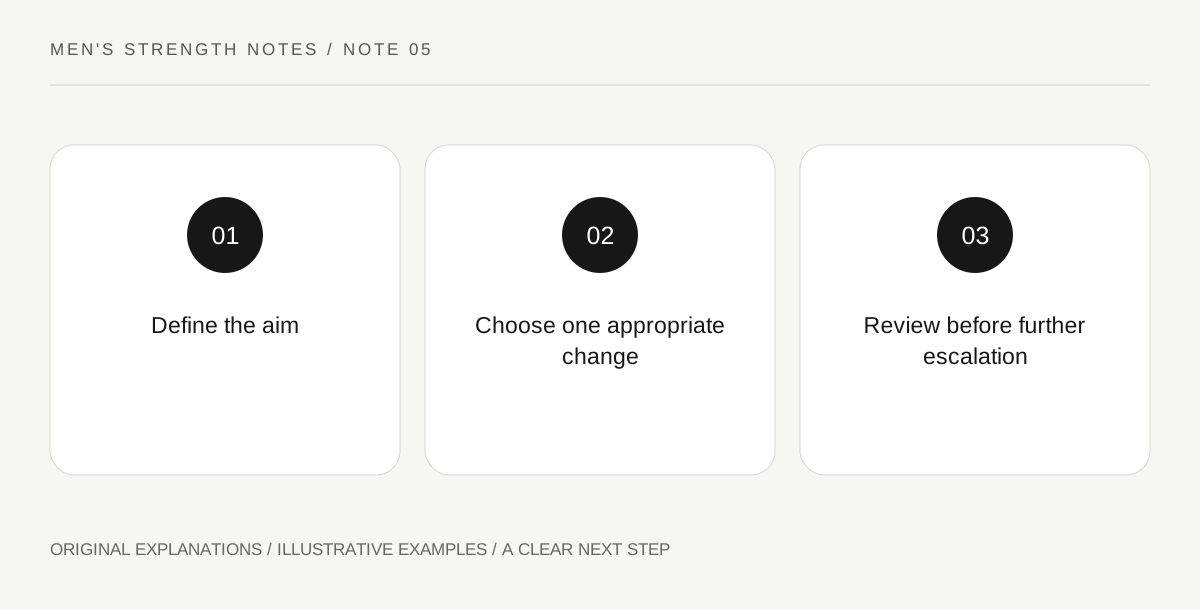
Original explanatory diagram. Read the full method and limitations below.
Name the goal of the change
Ask whether the plan is emphasizing technique learning, strength, muscle growth, endurance or another aim. These goals can overlap but do not make every variable interchangeable. ACSM's current resistance-training guidance recognizes different goals and individualized programs. A beginner does not need to optimize every outcome at once. Write the practical goal in ordinary language and ask what evidence of progress will be reviewed. A task may need several consistent sessions before a change is useful. Do not treat a slower increase as proof that a program is failing or that you need an advanced technique.
Progression can also involve doing the same task with clearer understanding. If a newly taught setup makes the movement more repeatable, record that learning before asking for a numerical increase. A small technical change may need time to settle into the routine. Ask what would count as enough evidence to review the next step. This prevents the plan from becoming a sequence of unrelated harder attempts and gives you a useful answer when a session feels different without an obvious change on the weight label.
Keep the current task stable enough to compare
Use the same appropriate exercise variation, equipment and setup when the plan calls for comparison. Note meaningful changes such as a different machine or coaching cue. If the task changes, the old load may no longer be the right reference. A stable comparison does not mean ignoring discomfort or forcing the same movement regardless of circumstances. It means preserving enough context to understand the result. Ask the instructor what should remain constant and what may be adjusted. A written review rule is clearer than a vague instruction to add more when it feels easy.
Choose one suitable variable with guidance
The appropriate next change might involve load, repetitions, sets or the exercise itself, depending on the plan. This article does not prescribe an increment or universal schedule. Ask how the chosen change should be applied and what would lead you to reverse or pause it. Do not simultaneously shorten rest to save time and increase load to prove progress without discussing the combined demand. If a new setup is being learned, that may already be a meaningful change. Keep the session understandable enough that you can report what differed and how the task was performed.
Review the change before adding another
Record the actual work and relevant observations, then follow the agreed review process. If technique or comfort becomes unreliable, stop and clarify rather than forcing the new target. A progression plan should include adjustment, not only escalation. Seek appropriate professional advice for pain or health concerns. Keep comparison with other people outside the decision; their training history and goals may be different. The useful outcome is a repeatable change that serves your plan. It does not need to produce a record every week, visible soreness or a fixed rate of muscle gain to justify its place.
An illustrative progression review
Theo and his instructor agree to keep a particular machine setup and rest arrangement consistent while reviewing repetitions. They do not also change the exercise and load in the same session. After observing the agreed pattern, they decide on one next adjustment. The example illustrates a decision process, not a prescribed progression schedule.
Practical checks
Optional checkboxes save only in this browser.
Questions that come up
Must the load increase every session?
No universal rule requires that. Progression depends on the person, goal, exercise and plan.
Can a harder variation count as a change even with the same weight?
Yes. Variation and setup can change demands. Record them rather than treating weight as the only variable.
References and scope
These sources support the factual background. Examples and exercises are original illustrative teaching material. References do not imply endorsement.
- ACSM: Updated 2026 Resistance Training Guidelines — Individualized training, consistency, equipment options and limits of advanced techniques for healthy adults.