Keep breathing in the strength lesson instead of discovering breath-holding under load
Beginners can concentrate so hard on a movement that they stop breathing without noticing. Breathing deserves an explicit place in the lesson. General public-health advice encourages breathing through strength work; specialized lifting techniques should not be copied from heavy-lift clips without qualified instruction and attention to personal health.
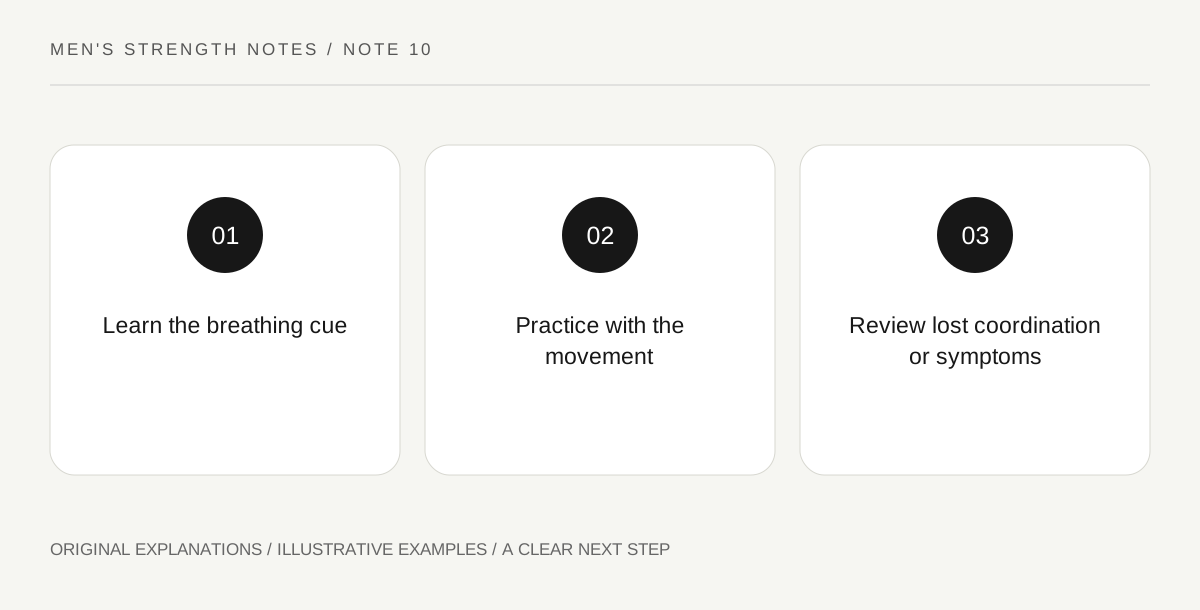
Original explanatory diagram. Read the full method and limitations below.
Ask for a breathing cue with the movement
Have the instructor explain the breathing pattern intended for the exercise while demonstrating a suitable teaching version. NIA advises against holding the breath during strength exercises and describes breathing out during effort and in during relaxation. Apply that general idea through the actual movement rather than guessing which phase counts as effort. A pull and a press can look different. Practice where you can hear the cue clearly and keep the setup manageable. Breathing instruction should be simple enough to remember alongside position and finishing, not a long list of competing commands.
Notice unplanned holding without making a diagnosis
If you realize you have been clenching and holding your breath, stop safely and discuss the attempt. Do not treat facial redness or a strained expression as a reliable medical measurement. The relevant observation is that the taught pattern was lost or the task felt too demanding to manage. Ask whether the load, complexity or instruction needs adjustment. A general article cannot determine cardiovascular safety from an exercise description. If you have a health condition, concerning symptoms or uncertainty about appropriate exertion, seek qualified clinical advice rather than relying on a gym cue alone.
Practice the cue without trying to count several systems simultaneously. If repetitions, tempo and breathing all compete for attention, ask the instructor which cue to prioritize during the learning attempt. They may be able to simplify the task or speak the count while you focus on the movement. The answer should fit the exercise and your needs. A teaching method that reduces confusion is more useful than telling a beginner to remember everything at once under a demanding load.
Keep advanced techniques in their proper context
Some experienced lifters use specialized bracing and breathing strategies under specific coaching. An edited clip does not teach their purpose, suitability or risks. Do not assume a heavy barbell technique is the starting method for every man who wants to become stronger. General fitness and competitive lifting can require different decisions. Ask the instructor to explain what you are being taught and why. Avoid using a belt, a breath-holding cue or a dramatic grunt as a substitute for understanding the exercise. Equipment and appearance do not establish that you are managing the task appropriately.
Build breathing into repeatable practice
Record one clear cue if it helps, and ask the instructor to observe whether it remains usable across the planned work. If you cannot coordinate the movement and breathing, simplify the learning task with appropriate guidance rather than forcing faster repetitions. Stop for concerning symptoms and obtain appropriate help; a breathing pattern is not a way to push through chest pain, faintness or severe breathlessness. The lesson succeeds when the movement, breathing and finish are understood together. It does not require copying a performance ritual or proving that you can tolerate an uncomfortable attempt in silence.
An illustrative coaching cue
Adam notices he stops breathing during a new machine exercise. He returns the equipment safely and asks the instructor to demonstrate a simple cue through an appropriate practice attempt. They review the task before continuing. Adam does not copy breath-holding from a competitive lifting video to make the set look more serious.
Practical checks
Optional checkboxes save only in this browser.
Questions that come up
Should every beginner copy powerlifting breathing?
No. Specialized methods have context and instruction needs. Learn an appropriate pattern for your task and circumstances.
Can a breathing cue make concerning symptoms safe?
No. Stop and seek appropriate help for concerning symptoms rather than using a cue to push through them.
References and scope
These sources support the factual background. Examples and exercises are original illustrative teaching material. References do not imply endorsement.
- NIA: Types of Exercise and Physical Ability — Strength activity, breathing without holding the breath and different activity roles.