Ask what an appropriate movement range means for your exercise
An exercise's range is not determined by how far a flexible person moves in a video. Equipment, body proportions, skill and health can affect the appropriate task. A beginner needs a clear demonstration and a way to discuss discomfort, without forcing a position to match a diagram or adopting a permanently shortened movement on guesswork.
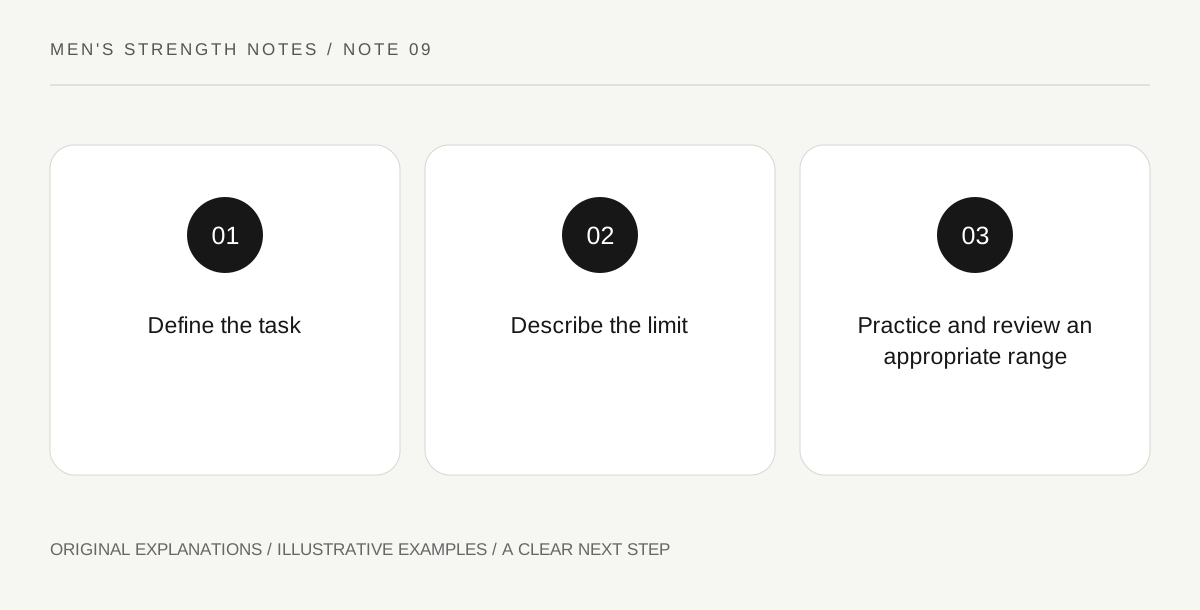
Original explanatory diagram. Read the full method and limitations below.
Define the exercise before discussing range
Confirm the exact variation and intended setup with a qualified instructor. A seated machine, free-weight exercise and rehabilitation movement can use similar names while serving different purposes. Ask where the taught movement starts and ends for you on that equipment. NSCA notes that machine designs do not fit every body equally. A range control or seat adjustment is not merely cosmetic. Learn its intended use and avoid changing it under load unless the instructions permit that method. If the equipment cannot accommodate you comfortably, ask about an appropriate alternative.
Clothing or an equipment pad can also change your perception of the endpoint. Tell the instructor when you feel blocked by contact rather than by the intended movement. Do not remove a safety feature or alter equipment to create more distance. A suitable adjustment or alternative may solve the access problem. Keeping the source of the limit clear helps avoid the mistaken conclusion that every restricted-looking movement needs stretching, more load or a stronger effort.
Describe the limiting experience accurately
Explain whether the issue is pain, uncertainty, a pad blocking movement, loss of position or simply unfamiliarity. Those observations lead to different questions. Do not label every limit as tightness that must be stretched away. Equally, do not assume a smaller movement is automatically the correct long-term answer. A clinician may be needed when symptoms, injury or a health condition affects the task. Keep the description concrete: the handle reaches this point and I lose the taught position is more useful than my body is wrong. Avoid self-diagnosing joint damage from an uncomfortable attempt.
Use coached practice to clarify the boundary
Have the instructor observe an appropriate practice attempt and explain the relevant cues. Ask whether a setup change, a different variation or further assessment is needed. Do not bounce or use extra momentum to reach a position you cannot control. An online diagram cannot feel the equipment fit or respond to your explanation. If the instruction remains unclear, pause rather than guessing during a demanding set. The purpose is learning a suitable task, not proving flexibility or maximizing distance at any cost. A useful lesson should leave you able to describe the boundary and the reason for it.
Keep the agreed range visible in later sessions
Record a professional instruction that meaningfully affects the exercise and review it when circumstances change. Do not quietly expand a clinically advised limit because a session feels easy, or permanently preserve an old temporary restriction without asking about follow-up. Compare log entries only when the task is similar enough. A larger weight moved through a very different range does not establish the same kind of progress. Seek care for persistent or concerning pain. The practical goal is appropriate, repeatable movement within a plan, with room for learning and reassessment rather than a universal rule taken from a photograph.
An illustrative range discussion
Ben cannot use a machine's starting position comfortably. He explains where the problem occurs and asks an instructor to check the setup. They identify that the model does not fit the intended task well and choose an appropriate alternative. Ben does not force the position or infer a medical diagnosis from the mismatch.
Practical checks
Optional checkboxes save only in this browser.
Questions that come up
Should I copy the deepest position in a video?
No. A video does not assess your setup, body or health. Learn the appropriate task with qualified guidance.
Does a shorter movement always mean safer training?
Not automatically. Range should be appropriate to the exercise and person, with clinical advice where needed.
References and scope
These sources support the factual background. Examples and exercises are original illustrative teaching material. References do not imply endorsement.
- NSCA: Types of Resistance Training Equipment — Machine and free-weight differences, adjustment, fit and equipment demands.
- NIAMS: Sports Injuries — Injury symptoms, risk factors and the limits of self-assessment.