When equipment is busy, preserve the exercise goal before choosing a substitute
A crowded gym can turn a clear plan into a series of guesses. The nearest free machine is not automatically an equivalent exercise. A useful substitution preserves the intended role while accounting for skill, setup and load, and it is best agreed before the queue appears.
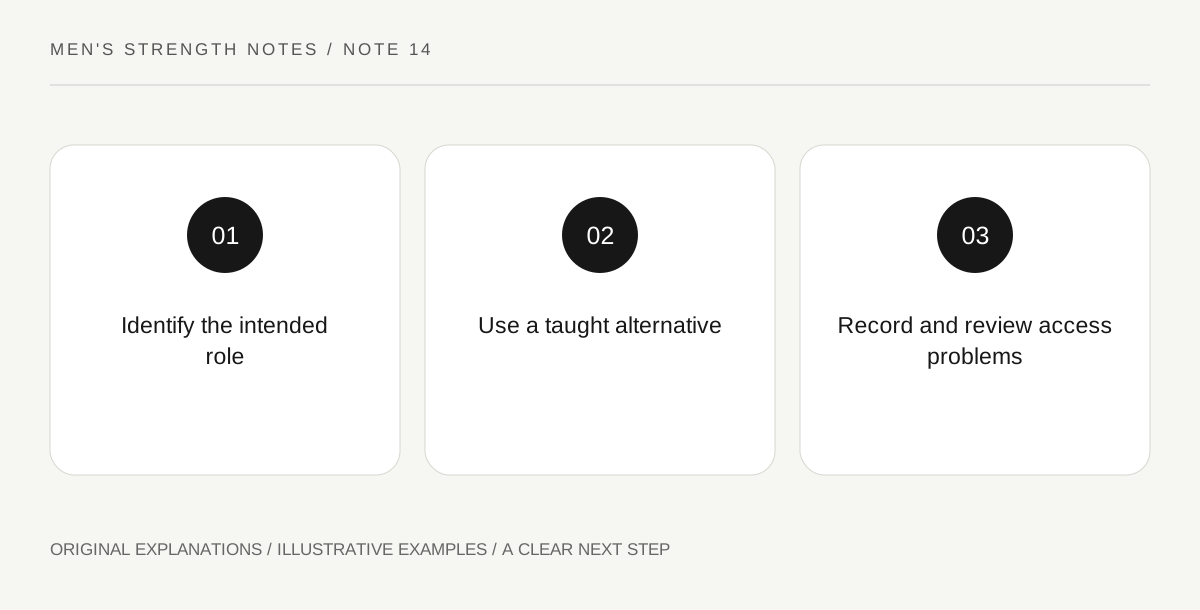
Original explanatory diagram. Read the full method and limitations below.
Ask what the original exercise is doing in the plan
Identify the exercise variation and its role rather than only the body-part label. A movement may have been chosen for support, learning, a particular range or available equipment. A different machine aimed at the same general area may not preserve those features. NSCA describes meaningful differences between equipment types and movement demands. Ask your instructor what needs to remain similar in a substitute and what can change. A clear explanation gives you a smaller, more useful set of alternatives than searching for every exercise associated with the same muscle on an app.
Prepare alternatives before the session
Ask for one or two appropriate options and learn their setup while instruction is available. Do not wait until the gym is crowded to attempt an unfamiliar free-weight version. Record the alternative as its own exercise, including settings and initial-load guidance. A suitable substitution may use a different load or repetition arrangement, so do not transfer the old number automatically. The plan should also say when waiting, changing order or omitting a task is acceptable. Those decisions depend on the program and circumstances rather than a universal rule that every planned line must be completed at any cost.
Prepare a short alternative list in the order the instructor recommends, with a clear point at which you ask for help. This avoids scrolling through dozens of unrelated options while occupying a station. If no taught alternative is available, use the agreed response rather than selecting the most impressive free exercise. A substitution rule can be concise: the original task, one learned option and what to do if neither is possible. It should remain a practical guide rather than a new program invented during the session.
Communicate clearly around shared equipment
Ask whether a machine is in use and follow venue rules for working in. Do not remove someone's plates or alter a setup while they are preparing a set. If sharing requires adjustments, make sure each person can restore the correct arrangement and use it safely. A rushed change between strangers can create confusion. It is reasonable to choose another suitable option when sharing is impractical. Keep equipment etiquette separate from technique advice; another member's confidence does not establish that their suggested substitution fits your plan or that they are qualified to assess your movement.
Interpret the changed session honestly
Record which alternative you used and any meaningful change in order or timing. Compare progress within the same task rather than treating two machines' displayed numbers as equivalent. If crowding repeatedly prevents the intended plan, discuss access and scheduling with the instructor or venue. The solution may be a different session structure rather than a larger exercise library. Keep symptoms and unfamiliarity visible. A flexible program can remain purposeful when it includes boundaries for substitutions; flexibility does not mean that every available movement is interchangeable or that a busy gym requires improvising a demanding exercise.
An illustrative crowded-gym choice
Kai's planned machine is occupied. He uses an alternative that his instructor has already taught and records it separately, including its own settings. He does not copy the original load or try a new barbell movement from a nearby poster. At review he mentions that the access problem occurs regularly.
Practical checks
Optional checkboxes save only in this browser.
Questions that come up
Can I use the same load on a substitute?
Do not assume so. Different equipment and variations can change the demand. Use appropriate selection guidance.
Is skipping an unfamiliar task better than guessing?
When safe instruction is missing, pause and clarify. Ask your instructor how omissions or alternatives should be handled in the plan.
References and scope
These sources support the factual background. Examples and exercises are original illustrative teaching material. References do not imply endorsement.
- NSCA: Types of Resistance Training Equipment — Machine and free-weight differences, adjustment, fit and equipment demands.