Choose machines and free weights by the task you can learn and repeat
Machines and free weights are often presented as rival identities. A beginner needs a more practical comparison: fit, support, learning demands, access and purpose. Neither category automatically proves seriousness or guarantees safety, and a useful program can use one or several equipment types without requiring a symbolic graduation.
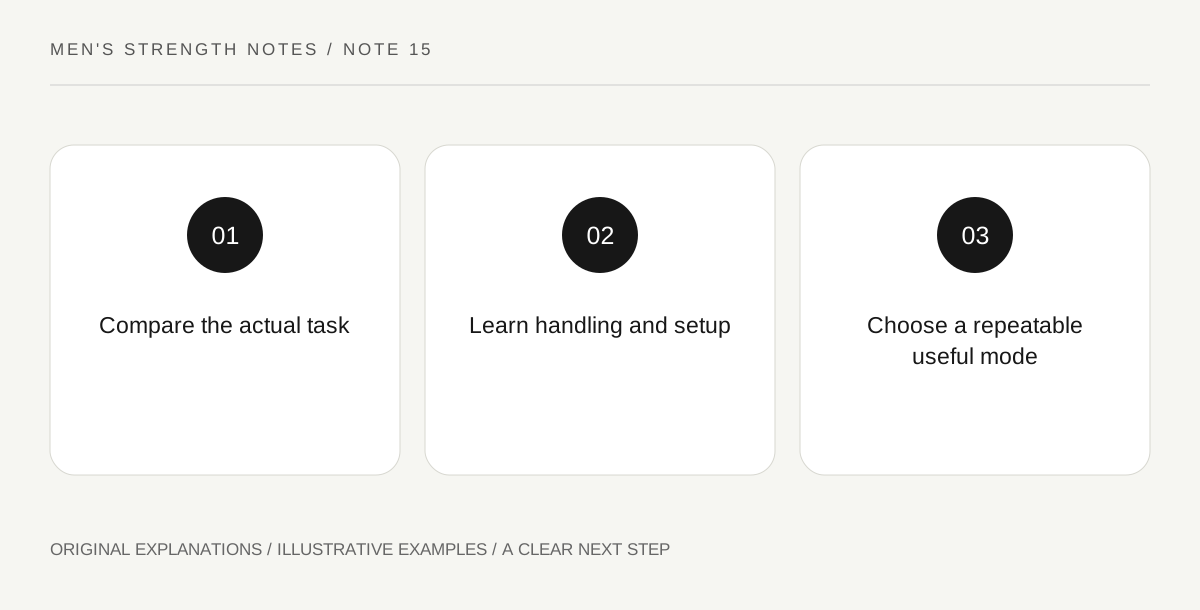
Original explanatory diagram. Read the full method and limitations below.
Compare the movement environment
Machines usually constrain movement differently from free weights, while designs vary within each category. NSCA explains that machines can offer support and a guided path, but fit can still be an issue. Free weights allow more freedom and require appropriate control. Ask which environment helps you learn the intended task. Do not conclude that guided movement removes every technique question or that freedom is always better. The relevant choice is specific: this machine or this free-weight variation for this person and goal, not an abstract contest between every machine and every dumbbell ever made.
Include setup and finishing demands
Think about loading, carrying, entry, adjustment, racking and storage as well as the movement itself. A free-weight exercise may require a safe way to move equipment into position, while a plate-loaded machine may require handling plates. A selectorized device may make changing the displayed load easier but still need clear adjustment. Ask for instruction across the whole task. The exercise does not begin only when the first repetition starts or end before the weight is returned. If a setup exceeds your current ability or understanding, choose an appropriate teaching arrangement rather than treating preparation as an unimportant obstacle.
Consider access and consistency
A program built around equipment that is never available may be hard to follow. Home space, travel, cost and gym crowding can affect the practical choice. ACSM's updated guidance recognizes several equipment modes as useful for healthy adults and emphasizes consistent participation. That does not mean every mode produces identical results for every goal. It does support asking what you can use appropriately and repeat. A modest setup with clear instruction may serve you better than a complex plan dependent on a crowded specialist area. Keep any needed substitutions taught and recorded rather than improvising under time pressure.
Test the practical burden before buying equipment for home. Ask whether you can store it securely, move it safely and use it in enough clear space for the intended exercise. A compact product can still require room around the body and a suitable setup. Cost should include any compatible accessories and instruction needed. This is a planning comparison, not a product review or a claim that a particular home implement provides every training function.
Avoid a mandatory graduation story
Learning a machine does not mean you must abandon it once you become stronger. Learning free weights does not require rejecting machines as inferior. Ask how an equipment choice serves the current plan and when a change would be useful. Record a new variation as a changed task with its own setup and load selection. Seek appropriate clinical advice for injuries or conditions rather than asking equipment categories to solve them automatically. The useful endpoint is confidence based on understanding and practice, not belonging to a camp or buying a particular implement to prove that training has become real.
An illustrative equipment choice
Patrick learns one movement comfortably on a suitable machine and another with a taught dumbbell variation. He keeps both because each serves a clear role and is available when he trains. He does not replace the machine simply because a friend says serious lifters eventually use only barbells.
Practical checks
Optional checkboxes save only in this browser.
Questions that come up
Must I progress from machines to barbells?
No universal progression requires that. Equipment should serve the person, goal and practical circumstances.
Are machines automatically injury-proof?
No. Fit, setup, intended use and technique still matter. Ask for instruction on the actual device.
References and scope
These sources support the factual background. Examples and exercises are original illustrative teaching material. References do not imply endorsement.
- ACSM: Updated 2026 Resistance Training Guidelines — Individualized training, consistency, equipment options and limits of advanced techniques for healthy adults.
- NSCA: Types of Resistance Training Equipment — Machine and free-weight differences, adjustment, fit and equipment demands.