One-sided exercises add a coordination task as well as a load
Training one side at a time can change balance, setup and how repetitions are counted. It is not simply half of a two-sided exercise. A useful lesson clarifies support, side order and the intended movement, while avoiding self-diagnosis of an imbalance from one unfamiliar attempt.
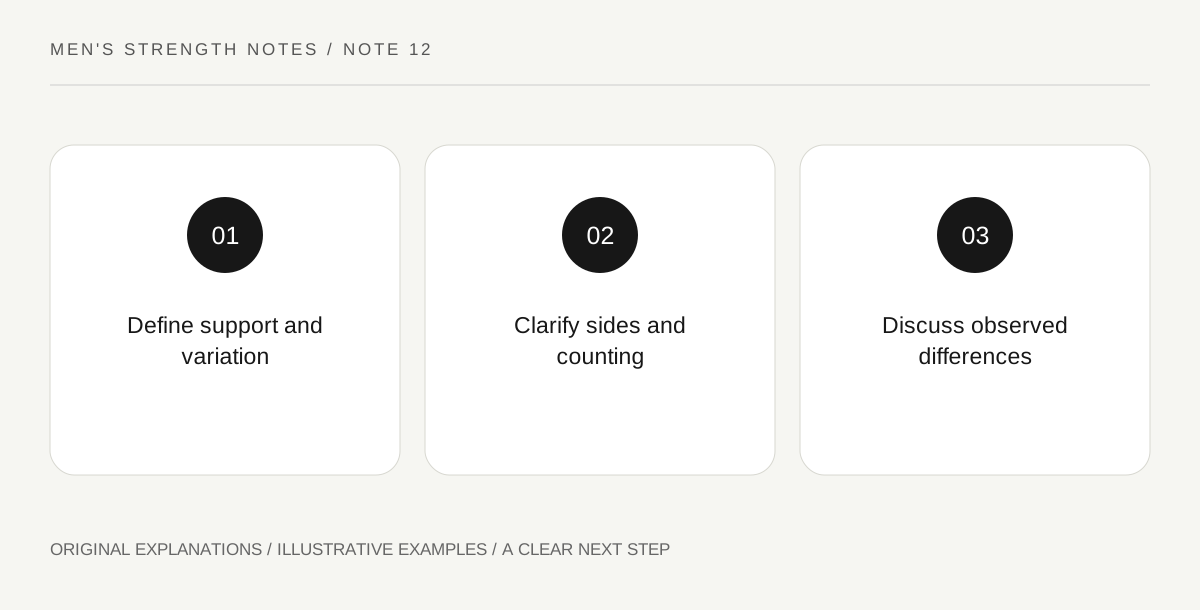
Original explanatory diagram. Read the full method and limitations below.
Identify the exact variation and support
Ask whether the exercise is meant to be supported, seated, standing or performed with another specified arrangement. A one-arm row with support and a standing one-arm press create different tasks. NSCA describes equipment and movement proficiency as relevant to selection. Do not remove a support to make an exercise look more advanced without discussing the change. Learn where the free hand, feet and equipment belong in the taught version. A general illustration cannot establish that a household chair is an appropriate support or that a particular balance demand suits your circumstances.
Clarify how the work is counted
Ask whether the target repetitions apply to each side, how side order is handled and where the planned pauses occur. Record those details. Ten alternating repetitions in total is different from ten per side, and switching sides can change the session's timing. Keep the equipment unit clear and do not double a load because only one hand is working. The purpose is following a suitable plan, not deriving a universal formula from a symmetrical body diagram. If an app leaves the notation ambiguous, resolve it before beginning rather than selecting the interpretation that produces the most work.
Observe differences without labeling a defect
One side may feel less familiar or coordinated during a new task. Describe what happens to the instructor rather than concluding that a muscle is weak, a joint is damaged or a posture needs correction. Pain or a persistent functional concern deserves appropriate assessment. Do not add extra sets to one side on your own to fix an assumed imbalance. A professional may need to distinguish skill, setup, fatigue and health factors. Keep the observation concrete: one side loses the taught position earlier is more useful than declaring your body uneven. Avoid comparing sides through an unplanned maximum effort.
Keep the lesson and progression connected
If a support, range or load is changed, note that the task changed too. Ask how the instructor wants the next session compared and whether the same arrangement should be used on both sides. A harder balance version is not automatically better for the original goal. Choose a variation that allows appropriate learning and repeatable execution. Stop if the setup becomes unclear or symptoms occur. The useful outcome is understanding a one-sided exercise within a plan, not proving that both sides can achieve an identical number in every condition or collecting asymmetry scores from a phone camera.
Consider side order as a recorded condition when the instructor thinks it matters. A side performed second may feel different after the first side's work or because the setup was restored differently. This does not explain every difference, but it is context worth preserving before drawing conclusions. Keep the task organized enough that an instructor can compare what actually happened. Avoid turning a single uneven attempt into a permanent rule about which side is allowed more work.
An illustrative side-count correction
Joel follows a card for a supported one-arm exercise but is unsure whether the listed repetitions apply per side. He asks before starting and learns the side order and pauses. When one side feels less coordinated, he describes that to his instructor rather than adding extra work to fix a presumed imbalance.
Practical checks
Optional checkboxes save only in this browser.
Questions that come up
Does a side difference prove injury?
No. An unfamiliar task can reveal several kinds of difference. Seek appropriate assessment for pain or persistent concerns.
Should I automatically train the weaker-feeling side more?
Do not improvise corrective work. Discuss the observation and the intended plan with a qualified professional.
References and scope
These sources support the factual background. Examples and exercises are original illustrative teaching material. References do not imply endorsement.
- NSCA: Types of Resistance Training Equipment — Machine and free-weight differences, adjustment, fit and equipment demands.
- MedlinePlus: Exercise and Physical Fitness — Exercise types, gradual participation and seeking advice when safety is uncertain.
- NIAMS: Sports Injuries — Injury symptoms, risk factors and the limits of self-assessment.