Give strength and aerobic activity separate places in the week
A strength session and an aerobic session can both be demanding while serving different roles. Treating gym fatigue as proof that every activity need is covered can obscure the week's pattern. A useful review identifies what each session contains and builds a feasible arrangement without prescribing one universal order or schedule.
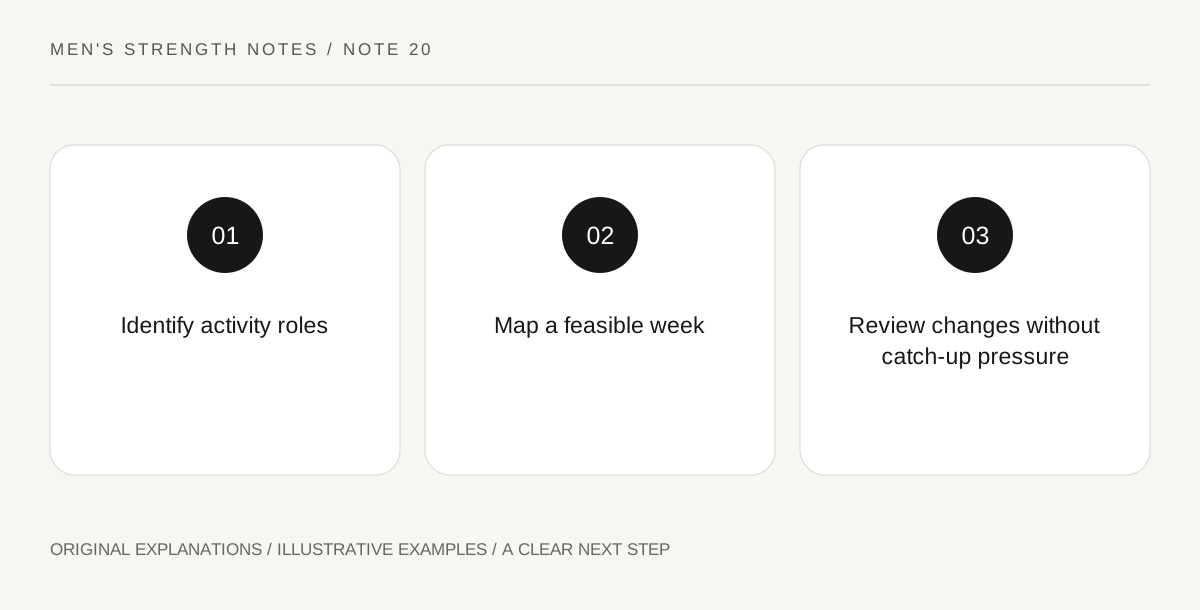
Original explanatory diagram. Read the full method and limitations below.
Identify the activity rather than the location
A gym visit might contain resistance work, treadmill activity, a class or a mixture. Record what you actually did instead of labeling every visit a full workout. CDC guidance includes both aerobic and muscle-strengthening activity for adults, with major muscle groups considered in strengthening work. A location does not determine which role an activity serves. A hard-feeling set is not automatically equivalent to a particular amount of aerobic activity. Keep the broad categories visible while recognizing that personal abilities and health conditions can affect appropriate participation and the advice you need.
Map the actual week and its constraints
Include work, caregiving, travel and recovery demands before adding sessions. A plan that fits only an imaginary empty week will be difficult to repeat. Choose realistic access points and discuss how different activities can be arranged with a qualified instructor when needed. This article does not prescribe a universal strength-before-cardio rule. Goals, session content and personal circumstances matter. If the available time is limited, ask how to prioritize and simplify rather than squeezing every planned activity into one exhausting block. Consistency can begin with a feasible structure rather than a perfect-looking calendar.
Keep changes in one activity visible to the other
A new demanding class, long hike or physical workday can affect how you arrive at strength training. Mention meaningful changes when reviewing the plan. Do not assume the body treats activities as unrelated because they appear in different apps. At the same time, avoid diagnosing overtraining from an ordinary tired day. Describe function, symptoms and context accurately. Seek clinical advice for concerning or persistent problems. An instructor can help review training organization within their role, while medical evaluation addresses health questions. Keep those roles distinct rather than using a schedule to explain away symptoms.
Review participation without a catch-up debt
If the week changes, use an appropriate revised plan rather than cramming missed sessions together as punishment. Ask how to preserve the most useful work within your circumstances. Keep planned and completed activity separate, and review barriers such as transport or crowding. A shorter suitable session can still be part of a worthwhile pattern. The useful outcome is a week whose components you understand and can carry out, with room for adaptation. It does not need a daily exhaustion score, a rigid split or a claim that one combination guarantees a particular physique.
Keep the purpose of a rest day clear in the program. A day without a strength session may still contain work, travel or ordinary activity, and it does not automatically require complete inactivity. Equally, it is not an invitation to add an unplanned demanding workout because the calendar looks empty. Ask how the week is intended to fit together. A realistic schedule acknowledges the whole person's demands instead of treating each training entry as an isolated event.
An illustrative weekly map
Andre realizes that his three gym visits contain only resistance work, while he had assumed the visits covered every activity role. He reviews the week with an instructor and chooses suitable aerobic opportunities that fit his circumstances. When work becomes demanding, they adjust the plan rather than combining missed sessions into one catch-up day.
Practical checks
Optional checkboxes save only in this browser.
Questions that come up
Does being tired after lifting prove aerobic guidance is met?
No. Fatigue alone does not identify activity type or amount. Look at the actual work and relevant guidance.
Must strength always come before aerobic work?
There is no single schedule prescribed here. Order should fit the goal, session and person, with qualified guidance when needed.
References and scope
These sources support the factual background. Examples and exercises are original illustrative teaching material. References do not imply endorsement.
- CDC: Adult Activity Overview — Adult activity guidance includes aerobic activity and strengthening all major muscle groups.
- NHLBI: Physical Activity and Your Heart — Different forms of physical activity and broader health context.