A useful technique lesson ends with you explaining the task back
A demonstration can feel clear until the instructor steps away. A short teach-back shows whether you understand the setup, movement, finish and reason for the exercise. It also helps you evaluate the teaching relationship, without treating confidence, physique or social-media popularity as evidence of relevant qualifications.
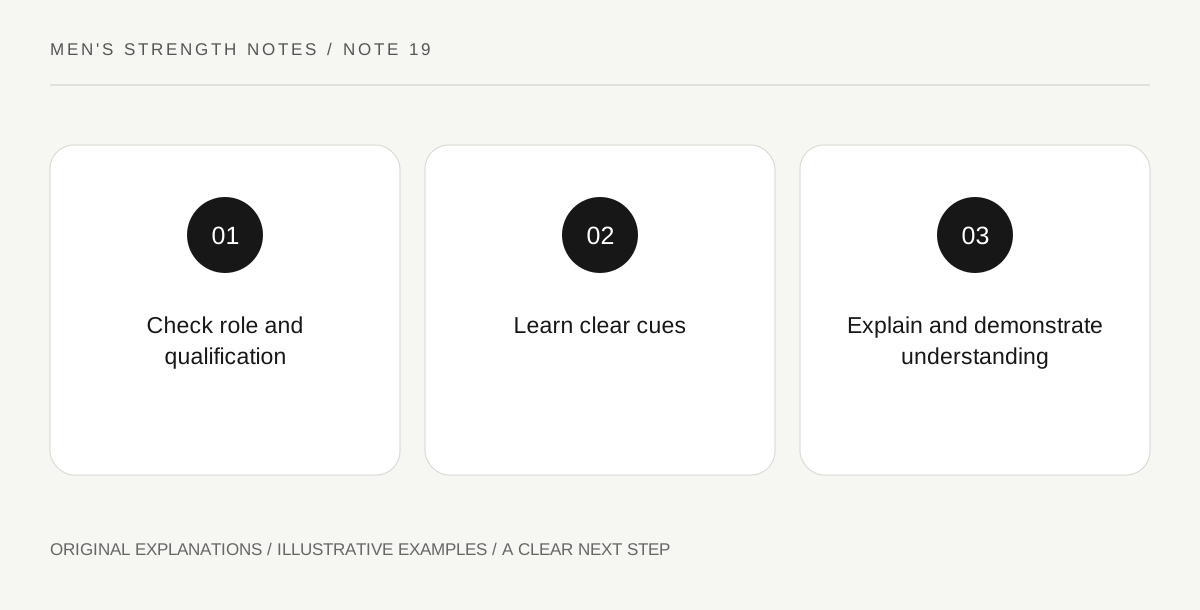
Original explanatory diagram. Read the full method and limitations below.
Check the instructor's role and credential
Ask about relevant current qualifications and verify a claimed credential with its issuing body when possible. NSCA provides a verification route for its certifications. A credential is useful information but does not by itself guarantee that the person fits every need. Clarify whether the service is general fitness instruction or clinical rehabilitation. Medical concerns belong with an appropriately qualified clinician. Ask how the instructor handles questions, consent and feedback. A good-looking demonstration or a personal transformation story cannot establish that someone can assess your health or teach the particular task you need to learn.
Ask for a small number of useful cues
A lesson should make the exercise understandable rather than fill your attention with competing instructions. Ask which setup points matter first and what the instructor wants you to observe. Have the movement demonstrated from a view you can understand without placing yourself in someone else's working space. If hearing, vision, language or another access need affects learning, discuss an appropriate format. A cue that makes sense to one person may be confusing to another. Request clarification in ordinary words instead of pretending to understand because the instructor uses technical language confidently.
Explain the whole task back
Before independent practice, describe entry, settings, movement, intended work and finish in your own words. Include what to do if the task feels wrong or cannot be completed as planned. The instructor can correct a misunderstanding before it becomes a loaded attempt. This is a learning technique, not a test designed to embarrass you. Ask for a brief written note or demonstration record if permitted and useful. Avoid filming others or assuming a video replaces feedback. A good teach-back can reveal that the main movement was understood while the racking or adjustment procedure was still missing.
Ask the instructor to give feedback in a way you can use. Some people prefer a demonstration, others a short verbal cue or a written reminder. Consent matters if hands-on guidance or recording is proposed. A teaching preference is not an excuse to avoid correction; it is a way to make correction understandable. If the same cue repeatedly fails to communicate, ask for another explanation rather than assuming the problem is simply a lack of effort.
Review the relationship through observable teaching
After the lesson, ask whether questions were answered, boundaries respected and instructions usable. If a cue remained unclear, bring that specific point to the next session. You should not be pressured to ignore pain, buy supplements or attempt a maximum to prove motivation. If the service does not fit, seek another appropriately qualified option. A useful lesson leaves you more able to explain and repeat a suitable task, not merely exhausted or impressed. Keep the instructor's commercial recommendations separate from the teaching question, and obtain clinical advice when symptoms or health conditions require it.
An illustrative teach-back
Miles learns a machine exercise and explains the seat setting, movement and finish to his instructor. His explanation reveals that he misunderstood how to return the handle before standing. They correct that point during appropriate practice. Miles keeps a short note and judges the lesson by clearer understanding rather than how sore he feels.
Practical checks
Optional checkboxes save only in this browser.
Questions that come up
Is teach-back an exam?
No. It is a way to reveal misunderstandings while support is available and to make instructions clearer.
Does a trainer's physique prove teaching competence?
No. Ask about relevant qualifications, scope and observable instruction rather than appearance alone.
References and scope
These sources support the factual background. Examples and exercises are original illustrative teaching material. References do not imply endorsement.
- NSCA: Certification Verification — Checking a claimed NSCA credential through its issuing organization.
- MedlinePlus: Exercise and Physical Fitness — Exercise types, gradual participation and seeking advice when safety is uncertain.