Check program coverage without inventing a perfect push-to-pull ratio
A beginner can learn several familiar upper-body exercises while leaving other major muscle groups out of the plan. A coverage review makes the pattern visible. It does not require an exact internet ratio, a different exercise for every small muscle or a personalized program created from a generic checklist.
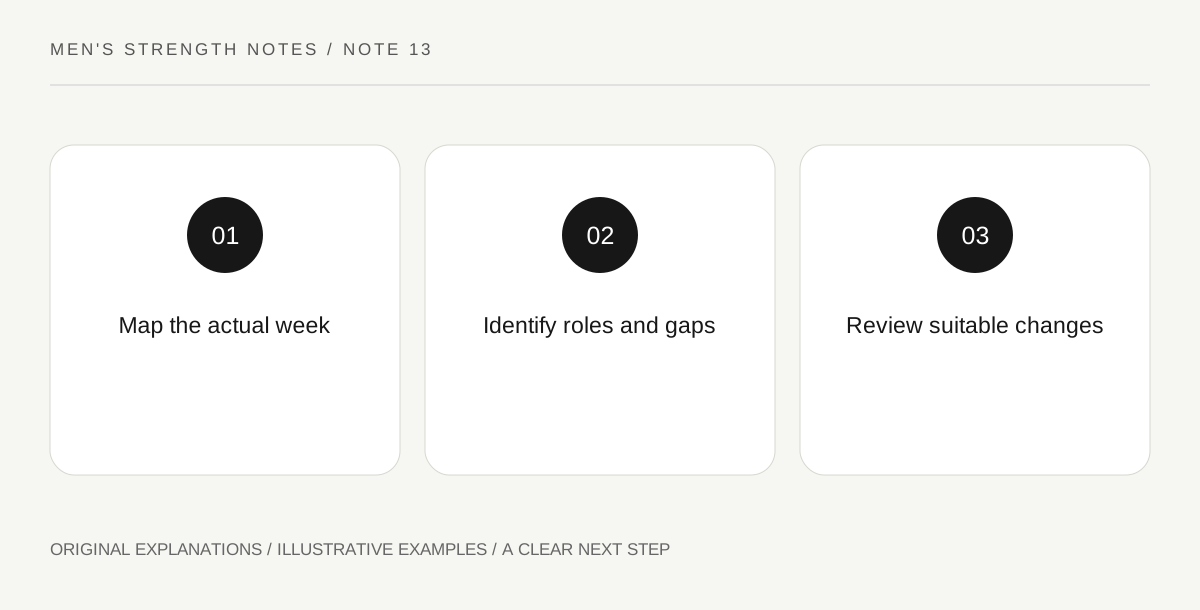
Original explanatory diagram. Read the full method and limitations below.
Read the week rather than one attractive session
List the exercises in the actual plan and the days on which they occur. Keep planned activity distinct from what was completed. CDC guidance includes muscle-strengthening work for all major muscle groups as well as aerobic activity. A single session need not be interpreted in isolation from the week. Ask your instructor how the overall plan addresses the relevant groups and your goals. Do not assume an exercise name tells the whole story or that a body-part label on a video covers every function implied by the title. The review is a conversation aid, not a substitute for program design.
Ask whether an exercise is present for a primary training role or for another reason, such as learning a movement or accommodating equipment access. One movement can serve several purposes, but counting it repeatedly under every possible label can create an inflated picture of coverage. A simple explanation from the program's author is more useful than a colorful body map with many highlighted areas. Keep the week's actual execution attached to that explanation.
Notice familiar-exercise bias
People often repeat movements they understand or enjoy. That preference can be useful for consistency while leaving gaps if it determines the entire plan. A gym session with several similar presses is not automatically balanced because the exercises use different handles. Likewise, variety for its own sake can make learning difficult. Ask why each exercise is included and what role it serves. A clear answer helps you distinguish useful repetition from redundant complexity. The aim is not to remove favorites but to place them in a plan that addresses broader needs without adding an endless collection of accessories.
Use movement labels as questions
Push, pull, squat and hinge are common organizational labels, but they are not a universal medical assessment or a complete program by themselves. Ask the instructor how such labels are being used and what they omit. Do not enforce an exact push-to-pull set ratio taken from a post without understanding its context. Equipment, exercise choice, training history and goals affect interpretation. A larger set count does not necessarily mean greater coverage if the tasks overlap. Keep the discussion practical: what is the exercise meant to train, and how does it fit the rest of the week?
Review changes with the person responsible for the plan
If you repeatedly skip a movement because equipment is busy or the task is uncomfortable, tell the instructor. The completed pattern may differ from the intended coverage. Ask for an appropriate alternative or assessment rather than substituting a favorite automatically. Record any agreed change so the next review uses the current plan. An individualized arrangement can be simple and still purposeful. It need not use every machine or follow a complex split to count as strength training. The useful endpoint is understanding the plan's coverage and the reasons for its choices, with health concerns handled by the appropriate professional.
An illustrative weekly review
Dylan notices that the exercises he actually completes are mostly presses and arm work because he skips unfamiliar lower-body tasks. He brings the real pattern to his instructor, who reviews the learning and access barriers. They revise the plan appropriately rather than adding a rigid internet ratio to the same incomplete week.
Practical checks
Optional checkboxes save only in this browser.
Questions that come up
Does every session have to include every muscle group?
A personal program may be organized in different ways. Review how the full plan addresses major groups and goals with qualified guidance.
Is one universal push-to-pull ratio required?
Do not assume so. Labels and set counts need context and are not a complete individualized program.
References and scope
These sources support the factual background. Examples and exercises are original illustrative teaching material. References do not imply endorsement.
- CDC: Adult Activity Overview — Adult activity guidance includes aerobic activity and strengthening all major muscle groups.
- ACSM: Updated 2026 Resistance Training Guidelines — Individualized training, consistency, equipment options and limits of advanced techniques for healthy adults.